Topological Optical Field Manipulation via Double-Spiral Multi-Pinhole Arrays
published: 08 March 2025 | https://doi.org/10.63174/xdi-JKAY8075
Abstract
Topological optical field manipulation, as a cutting-edge field in modern optical control, aims to break through the dimensional limitations of traditional optical field regulation through synergistic multidimensional parameter interactions. Addressing the limitations of existing multimode vortex field generation methods in terms of phase singularity controllability and dynamic reconfiguration capability, this study proposes a novel paradigm for topological optical field manipulation based on double-spiral multi-pinhole arrays. By constructing coaxial nested double-spiral array models containing both co-rotating and counter-rotating configurations, this research systematically investigates the coupled modulation mechanisms of inner and outer spiral rotation directions and topological charge differences on optical field amplitude and phase distributions. Through establishing an analytical model of double-spiral array phase modulation combined with numerical simulations, we reveal the dynamic evolution patterns of topological vortex fields modulated by spiral arrays. The study demonstrates that co-rotating double-spiral arrays generate high-order vortex beams with concentric ring intensity distributions through superimposed phase gradients, while counter-rotating configurations induce petal-like intensity patterns due to chiral inversion. Furthermore, we discover that the periodic variation of phase centers is governed by the smaller topological charge in the double-spiral system, with a quantitative mapping relationship existing between topological charge differences and petal numbers in intensity profiles. This work establishes a correlation model between spiral array parameters and optical topological properties, providing a theoretical framework for dynamically generating programmable multimode vortex beams, showing significant application potential in optical micromanipulation, high-dimensional quantum state preparation, and super-resolution imaging.
1. Introduction
Optical field manipulation, as a frontier in optical science, is driving the evolution of modern optical technologies toward multidimensionality and intelligence through its forward-looking approaches. This technology achieves precise reconstruction and control of multi-beam topological optical fields by synergistically regulating multidimensional physical parameters such as amplitude, phase, polarization states [1], and higher-order spatiotemporal characteristics [2]. In recent years, with advancements in fundamental theoretical frameworks and breakthroughs in novel control methods, the field has demonstrated remarkable interdisciplinary leapfrog development. Researchers have developed innovative control mechanisms, such as vector field dynamic modulation based on metasurfaces [3] and advanced generation methods for structured beams (circular Pearce beams, swallowtail beams, etc.) with unique physical properties [4,5]. These advancements not only significantly enhance particle trapping efficiency in optical tweezers systems but also pioneer new application dimensions in nano-photonics. Notably, the establishment of cooperative multi-physical-degree-of-freedom modulation paradigms has enabled precise control of optical fields across spatial encoding, temporal evolution, and polarization topology, providing critical technical support to overcome performance bottlenecks in traditional optical systems. This has catalyzed breakthrough solutions in strategic fields including high-speed optical communications [6], super-resolution imaging [7], and quantum information processing [2,8]. These systematic innovations not only reconstruct the theoretical foundation of optical field manipulation but also establish a solid basis for optical engineering's quantum and integrated evolution.
Allen et al.'s 1992 [9] demonstration of orbital angular momentum (OAM) in vortex beams [10] opened new opportunities for optical manipulation through their unique topological properties [11]. To leverage these topological characteristics for more efficient [12] and stable [13] optical control, researchers introduced topological modulation methodologies. Multi-beam formation and control technologies enable independent beam manipulation through simultaneous phase and amplitude regulation, offering novel solutions for beam shaping [14] and high-quality holography [15]. Recent years have witnessed significant progress in multi-beam topological control across nano-photonics [16], quantum manipulation [17], and nonlinear systems [18].
Optical field manipulation encompasses multidimensional implementation approaches, primarily including spatial optical modulators (SLM) [19], metasurface modulation [20], optical crystal modulation [21], and helical phase plates [22]. SLM-based methods enable programmable topological control through dynamic wavefront phase redistribution, demonstrating exceptional flexibility in optical tweezers manipulation [23] and multidimensional communications [24]. Metasurface approaches utilize designed subwavelength meta-atoms to precisely control phase retardation and polarization responses at nanoscales, overcoming diffraction limits of conventional optics. Optical crystal modulation exploits intrinsic birefringence [25], combining electro-optic/magneto-optic effects to dynamically couple polarization states and propagation vectors, bridging classical physics with modern optical field control. As classical vortex generators [26], spiral plates convert Gaussian beams into OAM-carrying vortices through helical phase gradients, maintaining fundamental research relevance. Of particular interest is emerging spiral array modulation technology, which generates tunable OAM states through spiral symmetry, demonstrating revolutionary communication applications by exponentially enhancing channel capacity through orthogonal eigenstates. In precision engineering fields like bio-microscopy [27] and micro-laser processing [28], such structured fields exhibit unique mode selectivity and energy localization advantages. However, current research predominantly focuses on single-spiral configurations [22], with technical challenges persisting in double-spiral multi-pinhole arrays. Crucially, double-spiral arrays enable coherent superposition and dynamic control of multimode vortex fields through topological charge combinations and spatial phase matching. This innovative approach not only transcends dimensional constraints of single-spiral modulation but also constructs complex composite optical fields, opening new research dimensions in quantum state manipulation and super-resolution imaging.
In this study, we propose a double-spiral multi-pinhole array for topological optical field manipulation. By adjusting spiral rotation directions and topological charge parameters, we achieve precise optical field control to investigate intensity and phase characteristics of target optical modes. Theoretically, we establish a double-spiral array model simulating topological modulation processes. Through vector diffraction theory, we develop a numerical simulation framework to systematically analyze quantitative correlations between array rotation directions and vortex beam topological charges. Simulation results confirm parallel generation and dynamic control of multiple vortices through geometric parameter design, revealing intensity profiles and phase distributions under different topological charge differences through rotational configuration variations. Co-rotating double-spiral arrays generate annular intensity patterns, while counter-rotating configurations produce petal-like distributions with petal numbers determined by topological charge summation. Despite intensity variations, phase center distributions remain governed by the smaller topological charge in the double-spiral system. Therefore, systematic investigation of double-spiral optical field manipulation represents both an essential breakthrough beyond current technological limits and a critical strategic initiative for next-generation photonic dominance, demonstrating significant scientific value and research urgency.
2. Principle and Method
Figure 1(a) depicts the geometric configuration of a coaxial counter-rotating double-spiral array, where the inner and outer spirals exhibit opposite rotational directions and opening orientations. The inner spiral adopts a right-handed spiral, while the outer spiral follows a left-handed arrangement. For comparison, Fig. 1(b) shows a coaxial co-rotating double-spiral array with identical rotational directions and opening orientations for both spirals. The aperture units in both arrays are periodically spaced azimuthally and arranged radially according to a predefined gradient.
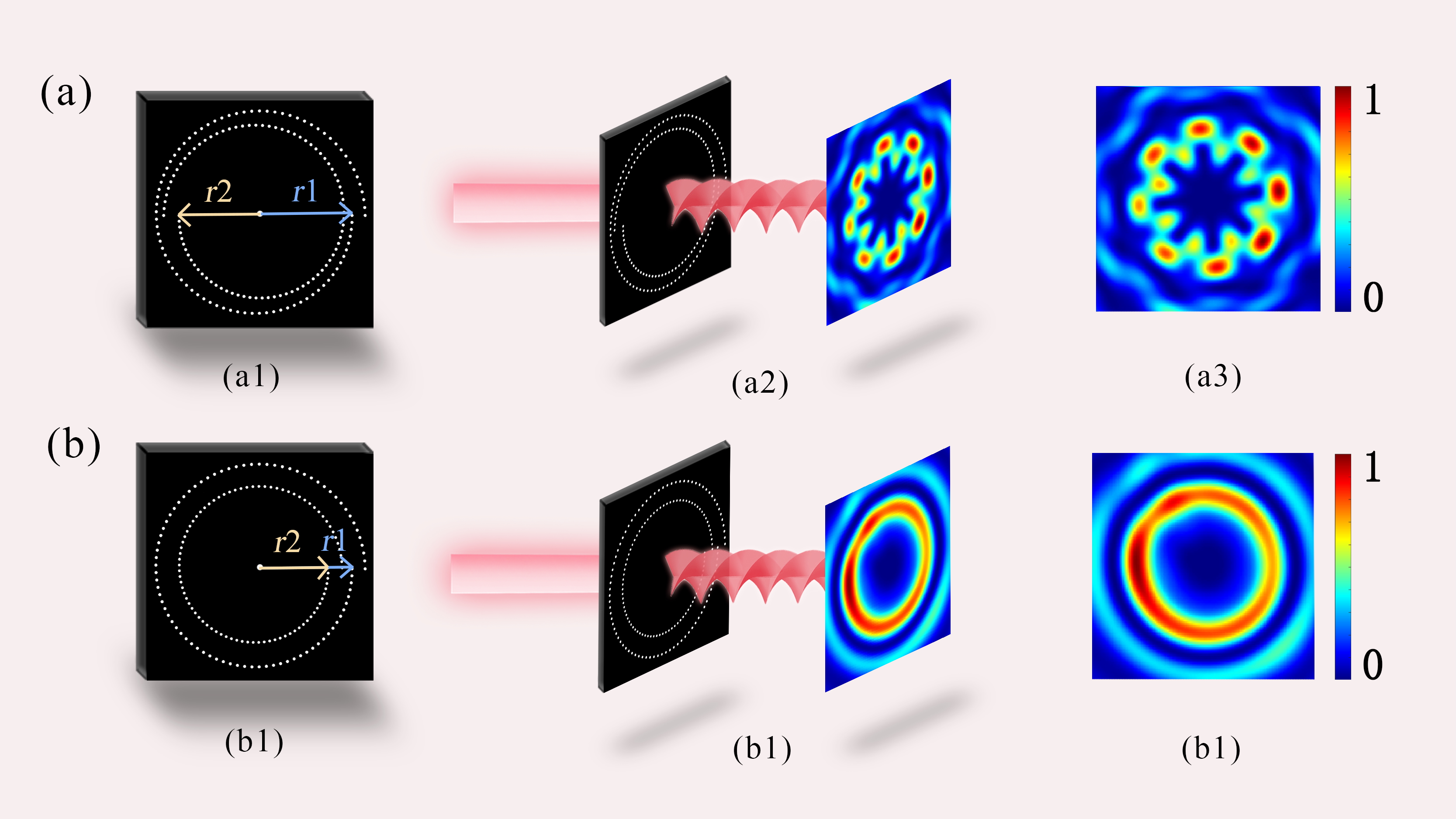
Figure 1. Schematic of vortex generation via double-spiral multi-pinhole array modulation. (a1) and (b1) show front views of coaxial co-rotating and coaxial counter-rotating double-spiral arrays, respectively. Each array comprises 2N pinholes arranged in a double-spiral topology, with pinholes marked by white dots. The initial radius of the outer and inner spirals are defined as r1 and r2, respectively. (a2) and (b2) illustrate the laser modulation processes of the double-spiral arrays. Despite their opposing rotational directions, both inner and outer spirals are assigned a topological charge of 4. (a3) and (b3) display front views of the corresponding near-field diffraction intensity distributions.
When a laser beam illuminates the double-spiral array, its phase distribution is modulated by the spiral arrangement of aperture units. Specifically, as the beam passes through each aperture, Fresnel diffraction induces equal-amplitude phase gradient increments along the spiral radius. During propagation, interactions between the optical wave and array units accumulate azimuthal phase differences among sub-beams, ultimately forming vortex beams with helical phase wavefronts.
Figures 1(a3) and 1(b3) reveal that counter-rotating spirals with opposing opening orientations produce asymmetric petal-like intensity distributions, while co-rotating configurations generate annular intensity patterns. These optical field modulation characteristics arise from distinct coherent superposition effects caused by phase modulation differences between configurations, manifesting as significant alterations in amplitude, phase, and topological charge parameters.
3. Simulation and discussion
Based on the optical field modulation model of the double-spiral array described above, structural analysis reveals that the similarity or difference in rotational direction and opening orientation of coaxial double-spiral arrays directly affects modulation performance. To investigate this, we systematically explored the modulation mechanisms of multi-beam topological optical fields by combining theoretical modeling and numerical simulations. By varying the rotational directions and topological charge parameters of the inner and outer spirals, we analyzed and summarized the characteristics of the modulated topological fields.
The simulation system employs a plane wave source with wavelength λ=1550 nm. The 1550 nm wavelength is widely used in optical communication and sensing applications due to its low transmission loss, making it suitable for long-distance transmission and enabling theoretical analysis to closely align with actual light propagation behavior. The double-spiral array is positioned in the Fresnel diffraction zone at a propagation distance of z=1 m. The relatively short propagation distance in the Fresnel diffraction zone effectively preserves the phase and amplitude information of the light field, allowing for precise analysis of the light field modulation effects induced by the double-spiral array. Specifically, the initial radius of the outer and inner spirals are set to r₁=5 mm and r₂=3 mm, ensuring a constant radial difference between the spirals while providing an appropriate geometric scale for the helical structure, which ensures the clarity and observability of the light field modulation. When the pinhole count reaches N≥200, the array structure fully reconstructs the helical phase profile, and further increases in pinhole density exhibit saturation characteristics in optical field modulation effects.
In summary, the wavelength, propagation distance, and initial radius of the outer and inner helices are carefully selected based on a comprehensive consideration of light field modulation effects and simulation accuracy. These parameters provide reasonable and effective support for both the research and practical application of the system.
3.1 Coaxial spiral arrays with equal topological orders
For coaxial co-rotating double-spiral structures, the optical field intensity distribution exhibits a centrosymmetric concentric ring-shaped profile. As the topological charge l increases from 1 to 5, the optical field maintains a dark-core-concentric-ring composite structure. When the topological charge exceeds a critical threshold, the outer ring intensity gap shows an attenuation trend, ultimately leading to complete extinction of the outer ring intensity distribution. Phase analysis reveals that the spiral wavefront structure of the co-rotating double-spiral array maintains strict spatial continuity. The azimuthal phase in the central region undergoes a complete l×2π periodic evolution along the propagation direction, and the phase gradient distribution maintains a linear correspondence with the topological charge. The superposition effect of this phase gradient originates from the co-rotational motion of the inner and outer spirals. This results in a continuous helical wavefront in the phase distribution of the light field, which in turn forms a concentric ring-shaped intensity distribution.
For coaxial counter-rotating double-spiral structures, the optical field distribution undergoes mode reconstruction. Distinct from the ring-shaped distribution in the co-rotating configuration, the counter-rotating intensity profile exhibits angularly modulated petal-like structures within the 1-5 topological charge range, with spatial symmetry closely related to the parity of the topological charge. As the topological charge increases, the inner petal-like intensity exhibits nonlinear attenuation. Phase evolution analysis demonstrates that while preserving the overall spiral characteristics, the counter-rotating double-spiral structure also undergoes a complete l×2π periodic evolution.The formation of these petal-like structures originates from the phase gradient reversal induced by the counter-rotating motion of the inner and outer spirals. This phase reversal leads to destructive interference during the propagation of the optical field, resulting in the angularly modulated intensity distribution.
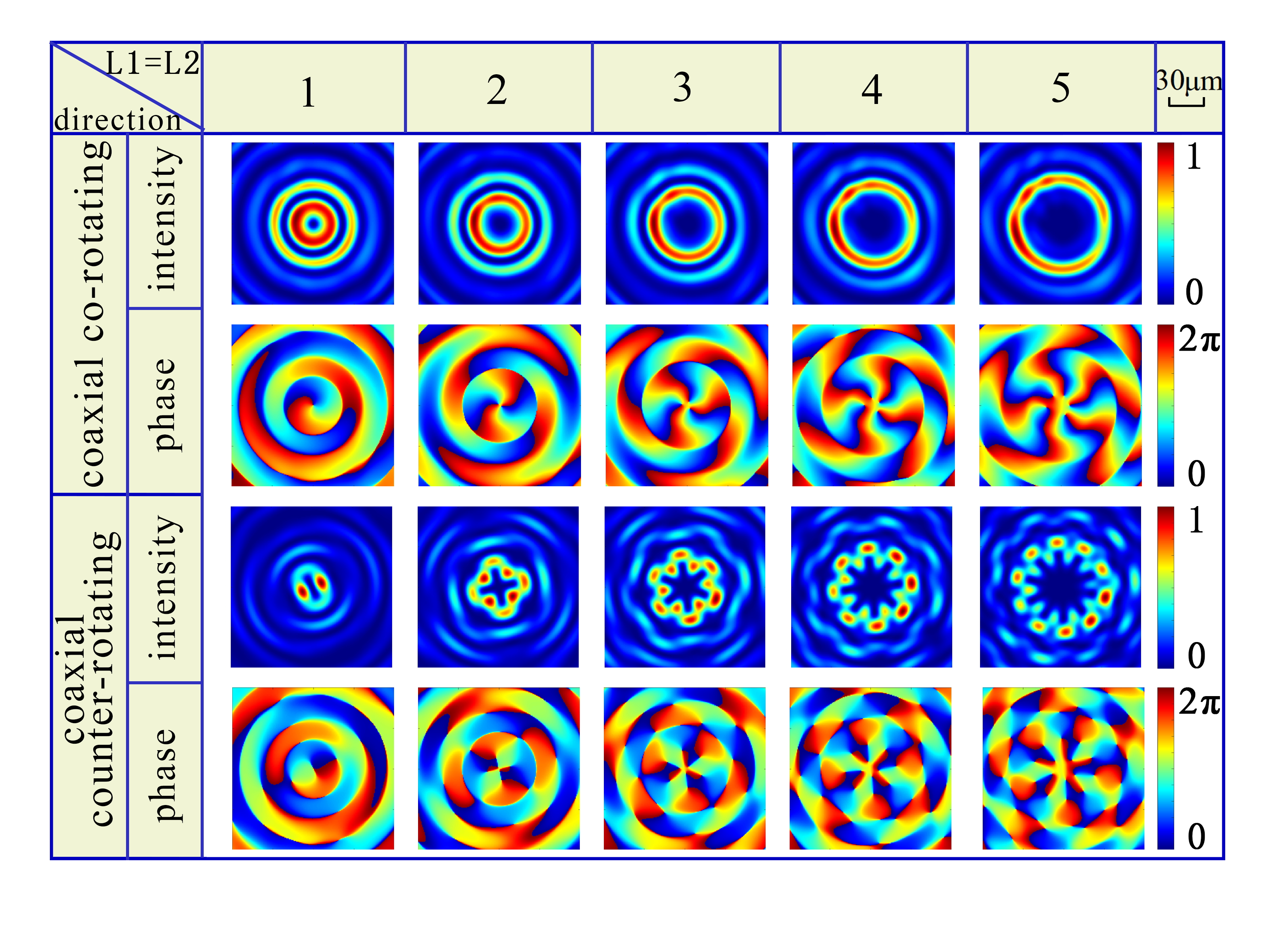
Figure 2. Schematic of intensity and phase distributions generated by coaxial co-rotating and counter-rotating double-spiral multi-pinhole arrays with identical topological charges. The topological charge of the outer spiral is denoted as L1, and the inner spiral as L2.
3.2 Coaxial counter-rotating spiral arrays with different topological chargers
As observed from Figure 3, the number of intensity petals corresponds to the superposition quantity of inner and outer spiral topological charges. From the horizontal dimension analysis, when L1 is fixed and L2 increases from l =1 to l =5 orders, the pattern evolves from relatively simple to complex structures. Taking L1=1 as an example, the L2=1 configuration shows concentrated central features, while higher L2 orders progressively develop more peripheral details and scattered bright spots, forming a petal-like structure with a central dark core.
Vertically, when L2 remains fixed and L1 increases from l=1 to l=5 orders, significant morphological changes occur. For L2=1, variations in L1 (1-5) alter both the quantity and spatial distribution of central bright spots. Notably, one distinct petal becomes prominently intensified while others weaken, concentrating optical energy within this dominant feature. This transforms the pattern from dual-spot configurations to multi-spot arrangements with enhanced regularity.
To further illustrate this relationship more clearly, the petal number can be enumerated under different combinations of topological charges. For instance: when L1=1 and L2=2, the petal number is L1+L2=3; when L1=2 and L2=3, the petal number is L1+L2=5; when L1=4 and L2=2, the petal number is L1+L2=6; when L1=5 and L2=3, the petal number is L1+L2=8; and when L1=3 and L2=4, the petal number is L1+L2=7. These examples demonstrate a clear linear relationship between the petal number and the superposition of the topological charges of the inner and outer spirals, enhancing the logic, completeness, and academic rigor of the discussion.
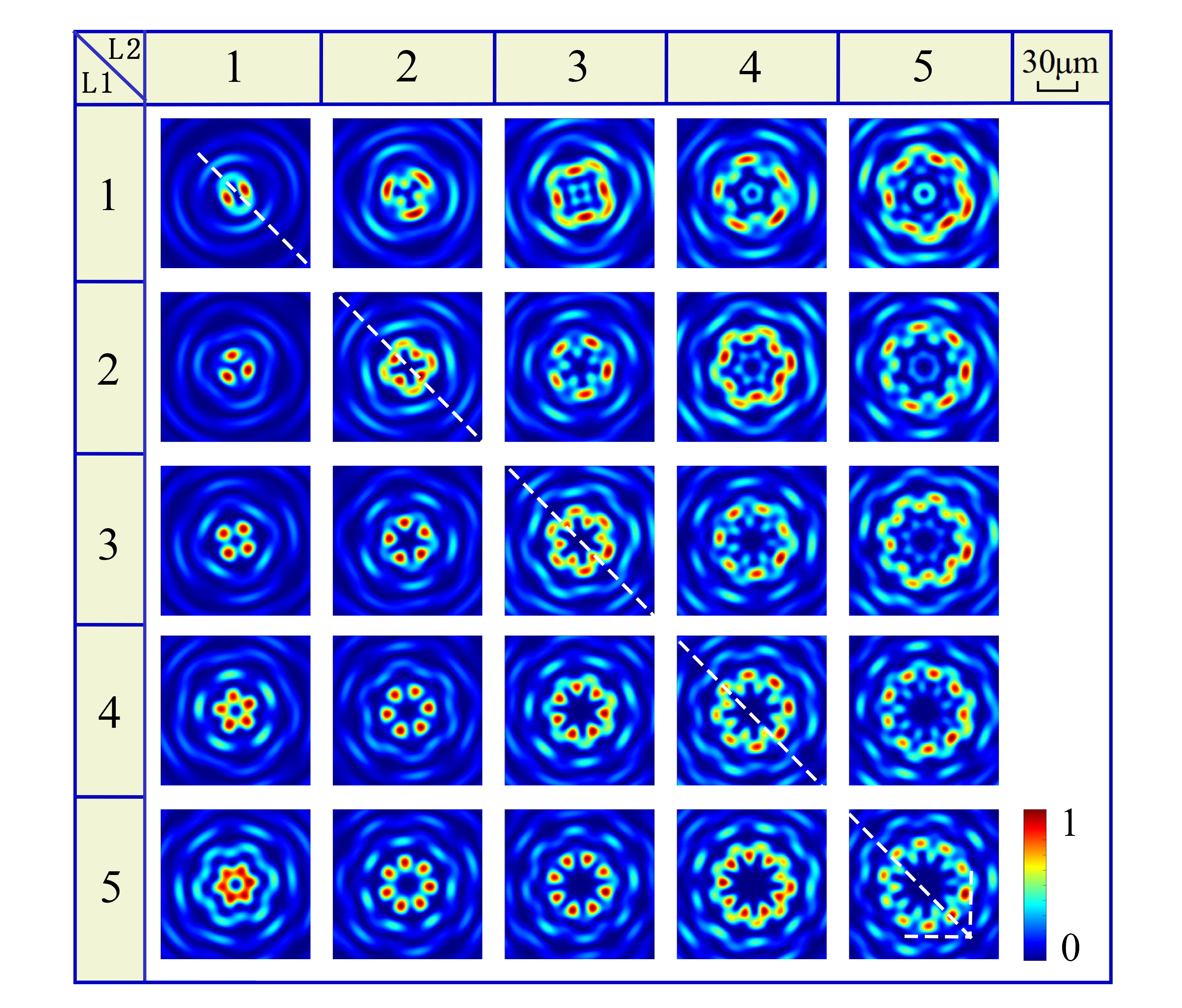
Figure 3. Each grid cell displays the topological optical field intensity patterns generated by a coaxial counter-rotating double-spiral multi-pinhole array under different topological charge configurations.
Along the diagonal direction (white dashed line, L1=L2), patterns demonstrate structural similarity and symmetrical distribution with increasing orders. All diagonal configurations exhibit well-organized centrosymmetric structures with uniform bright spot distribution and clear periodicity, maintaining petal-like intensity profiles from l =1 to l =5 orders. In off-diagonal regions (L1≠L2), symmetry weakens and structural diversity increases. Bright spot quantity, spatial arrangement, and morphology become L1/L2 dependent, with growing |L1-L2| values amplifying asymmetry and structural complexity.
As shown in Figure 4, the rotational periodicity of the phase center is determined by the lower-order topological charges in the inner and outer spirals. From horizontal parameter variation, when L1 is fixed at first-order and L2 increases from l=1 to l=5 orders, the structural complexity progressively evolves. The initial single-centered configuration gradually develops multiple concentric contours and radial branches, with the number of phase singularities proportionally increasing with L2 orders while maintaining a first-order core phase.
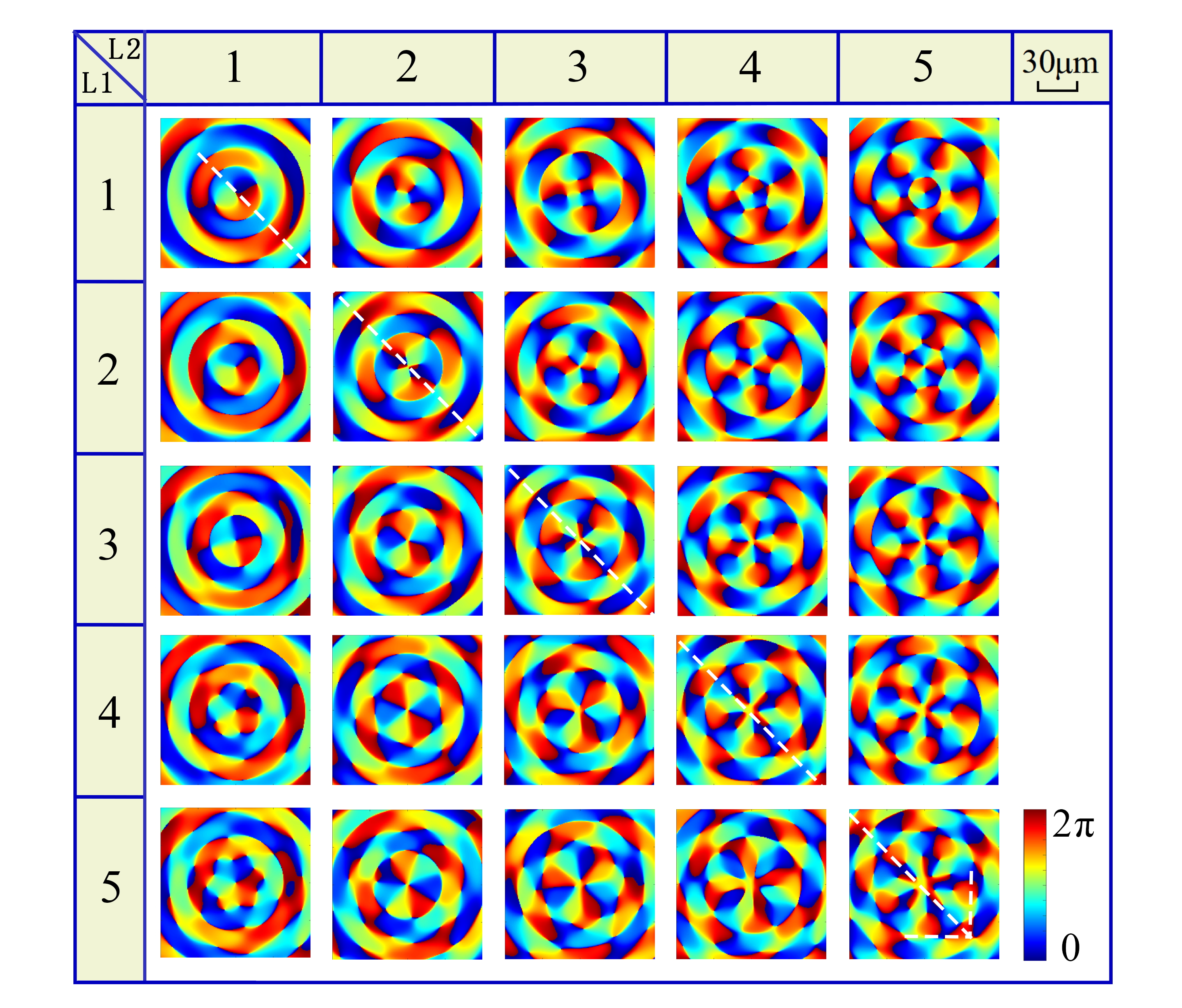
Figure 4. Each grid displays the topological optical field phase diagrams of coaxial counter-rotating double-spiral multi-pinhole arrays under various combinations of topological charge orders.
From vertical parameter variation, when L2 remains first-order and L1 increases, the central phase morphology transitions from a basic circular structure to multi-lobed patterns while retaining first-order characteristics. As L1 ascends, both structural complexity and angularly dependent gradient variations in phase coloration become pronounced.
Parameter combinations along the white dashed line (L1=L2) exhibit high regularity, demonstrating complete l×2π periodic evolution corresponding to the orders. In contrast, the phase distributions of off-diagonal combinations (L1≠L2) show dramatically enhanced morphological complexity as the parameter disparity increases. These changes in symmetry and complexity reflect the direct impact of the topological charge difference on the optical field structure, indicating that the difference in topological charge between the inner and outer spirals is a key factor in regulating the symmetry and complexity of the optical field.
3.3. Regularities and Summary of Optical Field Characteristics
Topological charge numbers and the rotational directions (co-rotating and counter-rotating) of the inner and outer spirals are critical parameters influencing optical field characteristics. Coaxial co-rotating and coaxial counter-rotating double-spiral multi-pinhole arrays exhibit distinct intensity and phase distribution patterns under varying topological charges. Proper selection of these parameters enables precise control over the optical field properties. Analysis of the intensity and phase characteristics of topological fields reveals the following regularities.
The relationship between the phase center variation ∆ϕ and the topological charge l is given by $\Delta \phi = l \times 2\pi$, as L1<L2, l =L1; L2<L1, l =L2. This relationship indicates that the central phase is governed by the lower-order topological charge. Additionally, in double-spiral arrays, changes in topological charges directly affect the intensity distribution. The number of petals in the intensity pattern corresponds to the superposition of inner and outer spiral topological charges. Optical fields modulated by double-spiral arrays with identical topological charges typically generate symmetric optical structures, demonstrating enhanced symmetry and stability. Further theoretical analysis indicates that the distinct relationship between spiral geometry, phase gradient accumulation, and interference effects can be explained through phase superposition. For co-rotating double-spiral structures, the in-phase superposition of phase gradients forms a continuous helical wavefront, while counter-rotating structures lead to destructive interference due to the out-of-phase superposition of phase gradients, thereby creating petal-like intensity distributions. The interplay between phase gradient accumulation and interference effects is key to understanding the modulation mechanisms of optical fields in double-spiral arrays.
4. Conclusion
This study proposes a novel method for dynamic control of topological optical fields based on double-spiral multi-pinhole arrays, achieving high-dimensional cooperative manipulation of spatial distribution and phase singularities through precise regulation of rotational directions and topological charge differences between inner and outer spirals. An analytical model of the double-spiral array was established based on diffraction theory, combined with numerical simulations to systematically reveal the modulation mechanism of the double-spiral structure on topological optical fields, demonstrating its unique advantages in vortex beam generation and optical field topological reconstruction.
Theoretical modeling and simulation results show that in coaxial co-rotating double-spiral configurations, the co-directional superposition of phase gradients from inner and outer spirals forms concentric ring-shaped intensity patterns. Conversely, coaxial counter-rotating configurations induce intensity redistribution into angularly modulated petal-like patterns through destructive interference caused by spiral chirality reversal, with petal numbers quantitatively following the sum of topological charges. Furthermore, the topological charge order arising from phase variation in optical fields is determined by the smaller topological charge in the double-spiral system.
The established correlation model between spiral parameters and optical field topological characteristics provides theoretical foundations for developing integrated quantum optical devices, metasurface imaging systems, and programmable vortex beam sources. The revealed topological field control principles not only enable enhanced particle trapping precision in optical tweezers through phase optimization, but also open new pathways for high-dimensional quantum entanglement state preparation and mode multiplexing in super-resolution imaging, demonstrating significant application potential in strategic fields such as quantum information processing and nano-photonics.
Conflicts of Interest
The authors declare that they have no known competing financial interests or personal relationships that could have appeared to influence the work reported in this paper.
Funding
Scientific and Technological Innovation Programs of Higher Education Institutions in Shanxi (STIP) (No. 2024L349, 2022L513); Open Project of Key Laboratory of Magnetic Molecules and Magnetic Information Materials of Ministry of Education (No. 2024-02).
Author contributions
Min Li: Conceptualization, Investigation, Writing - original draft, Writing - review & editing. Ying Wang: Software, Visualization, Writing - review & editing. Ying Zhang: Investigation, Data curation. Mingxin Hua and Gaozhi Miao: Resources, Validation. Huyan Yijun: Methodology, Formal analysis. Li Ma: Conceptualization, Writing - review & editing, Supervision, Project administration.
References
K. Dholakia, T. Čižmár. “Shaping the future of manipulation.” Nat. Photonics. 2011, 5, 6, 335-342.
I. A. Walmsley. “Quantum optics: Science and technology in a new light.” Sci. 2015, 348, 6234, 525-530.
Q. Li, J. van de Groep, A. K. White, J. H. Song, S. A. Longwell, P. M. Fordyce, S. R. Quake, P. G. Kik, M. L. Brongersma. “Metasurface optofluidics for dynamic control of light fields.” Nat. Nanotechnol. 2022, 17, 10, 1097-1103.
X. Lu, L. Tan, N. Liu, C. Chen, K. Chen, H. Wu, X. Xia, P. Zhang, P. Hong, B. Zou, L. Liang. “Optical trapping performance of circular Pearcey beams on Mie particles.” Phys. Rev. A. 2023, 108, 6, 063509.
H. Liang, X. Lu, K. Chen, H. Wu, N. Liu, L. Tan, S. Jiang, Y. Liang. “Trapping capability of circular swallowtail beams.” Phys. Rev. A. 2024, 109, 6, 063515.
Z. Song, Y. Zhang, M. Xu, M. Pu, M. Zhou, Y. Yu, J. Ding, S. Chen, N. Jiang, K. Qiu, X. Luo. “High capacity turbulence-resilient free-space chaotic optical communication based on vector optical field manipulation.” J. Lightwave Technol. 2024, 42, 24, 8647-8654.
P. C. Maurer, J. R. Maze, P. L. Stanwix, L. Jiang, A. V. Gorshkov, A. A. Zibrov, B. Harke, J. S. Hodges, A. S. Zibrov, A. Yacoby, D. Twithchen, S. W. Hell, R. L. Walsworth, M. D. Lukin. “Far-field optical imaging and manipulation of individual spins with nanoscale resolution.” Nat. Phys. 2010, 6, 11, 912-918.
J. P. Dowling, K. P. Seshadreesan. “Quantum optical technologies for metrology, sensing, and imaging.” J. Lightwave Technol. 2015, 33, 12, 2359-2370.
L. Allen, M. W. Beijersbergen, R. J. C. Spreeuw, J. P. Woerdman. “Orbital angular momentum of light and the transformation of Laguerre-Gaussian laser modes.” Phys. Rev. A. 1992, 45, 11, 8185.
A. M. Yao, M. J. Padgett. “Orbital angular momentum: origins, behavior and applications.” Adv. Opt. Photonics. 2011, 3, 2, 161-204.
X. Zhou, Z. Zhu, X. Xie, L. Yao, F. Fan, Y. Zhou. “Broadband Vortex Beam Modulating System Based on Electrically Controlled Liquid Crystal Devices.” Photonics-Basel. 2023, 10, 9, 1012.
Y. Ming Qing, H. Feng Ma, L. Wei Wu, T. Jun Cui. “Manipulating the light-matter interaction in a topological photonic crystal heterostructure.” Opt. Express. 2020, 28, 23, 34904-34915.
S. G. Je, H. S. Han, S. K. Kim, S. A. Montoya, W. Chao, I. S. Hong, E. E. Fullerton, K. S. Lee, K. J. Lee, M. Y. Lm, J. L. Hong. “Direct demonstration of topological stability of magnetic skyrmions via topology manipulation.” ACS. Nano. 2020, 14, 3, 3251-3258.
X. Li, X. Zhang, R. Zhao, G. Geng, J. Li, L. Huang, Y. Wang. “Independent light field manipulation in diffraction orders of metasurface holography.” Laser Photonics Rev. 2022, 16, 8, 2100592.
R. Li, L. Cao. “Progress in phase calibration for liquid crystal spatial light modulators.” Appl. Sci. 2019, 9, 10, 2012.
J. S. Jensen, O. Sigmund. “Topology optimization for nano-photonics.” Laser Photonics Rev. 2011, 5, 2, 308-321.
C. Hua, G. B. Halász, E. Dumitrescu, M. Brahlek, B. Lawrie. “Optical vortex manipulation for topological quantum computation.” Phys. Rev. B. 2021, 104, 10, 104501.
T. Dai, Y. Ao, J. Mao, Y. Yang, Y. Zheng, C. Zhai, Y. Li, J. Yuan, B. Tang, Z. Li, J. Luo. “Non-Hermitian topological phase transitions controlled by nonlinearity.” Nat. Phys. 2024, 20, 1, 101-108.
R. Li, L. Cao. “Progress in phase calibration for liquid crystal spatial light modulators.” Appl. Sci. 2019, 9, 10, 2012.
Q. Li, M. Wen, M. Di Renzo. “Single-RF MIMO: From spatial modulation to metasurface-based modulation.” IEEE Wireless Commun. 2021, 28, 4, 88-95.
O. V. Angelsky, A. Y. Bekshaev, G. S. Dragan, P. P. Maksimyak, C. Y. Zenkuva, J. Zheng. “Structured light control and diagnostics using optical crystals.” Front. Phys. 2021, 9, 715045.
S. N. Khonina, A. V. Ustinov, V. I. Logachev, A. P. Porfirev. “Properties of vortex light fields generated by generalized spiral phase plates.” Phys. Rev. A. 2020, 101, 4, 043829.
E. Schonbrun, R. Piestun, P. Jordan, J. Copper, K. D. Wulff, J. Courtial, M. Padgett. “3D interferometric optical tweezers using a single spatial light modulator.” Opt. express. 2005, 13, 10, 3777-3786.
M. L. Broekman, S. L. N. Maas, E. R. Abels. “Multidimensional communication in the microenvirons of glioblastoma.” Nat. Rev. Neurol. 2018, 14, 8, 482–495.
J. H. Burnett, Z. H. Levine, E. L. Shirley. “Intrinsic birefringence in calcium fluoride and barium fluoride.” Phys. Rev. B. 2001, 64, 24, 241102.
W. M. Lee, X. C. Yuan, W. C. Cheong. “Optical vortex beam shaping by use of highly efficient irregular spiral phase plates for optical micromanipulation.” Opt. let. 2004, 29, 15, 1796-1798.
V. Ntziachristos. “Going deeper than microscopy: the optical imaging frontier in biology.” Nat. Methods. 2010, 7, 8, 603-614.
L. Yang, J. Wei, Z. Ma, P. Song, J. Ma, Y. Zhao, Z. Huang, M. Zhang, F. Yang, X. Wang. “The fabrication of micro/nano structures by laser machining.” Nanomaterials-Basel. 2019, 9, 12, 1789.